
Joseph Albernaz
Joseph Albernaz is looking into poetry and other disordered devotions towards the real. He is the author of Common Measures: Romanticism and the Groundlessness of Community (2024).
[This text gathers and presents a selection of scattered fragments, culled from a much longer series of fragments on the writing of Sean Bonney and calendars that runs along two primary lines of inquiry: one that might be characterized as pertaining to time (namely: how to, and what it means to, pose the question: “What year is this?”), and the other as pertaining to space (namely: a preliminary investigation of the places where the dead live). The project on Bonney’s work from which these fragments are drawn itself appears to belong to a much, much larger project that proposes to sound the experience of descent.]
Noone could get used to living here.
Omania Square. They call it the Assembly of the Dead.
The Calendar is Broken. The Ruling Class are not Human.”
-Sean Bonney, Our Death
We know Sean Bonney’s “ACAB: Nursery Rhyme,” the final section of his poetic sequence “Corpus Hermeticum: On the Revolutions of the Heavenly Spheres” [link]. We know how it works like a revolving door whose glass has shattered: the alternating injunctions not to say X, and to say “fuck the police.” The negated utterances are varied, but the enjoined utterance is nearly always the same: say fuck the police. Yet in two other lines the injunction changes, first to “say ‘you are sleeping for the boss,’” and then at the close: “say no justice no peace and then say fuck the police.” Only one other time in the poem is the positive injunction changed from “say ‘fuck the police,’” the only time that it is hedged with a “perhaps”:
don’t say “happy new year” say fuck the police
perhaps say “rewrite the calendar” but after that, immediately
after that say fuck the police[1]
The negation of the new year, the greeting at the turning of the calendar, gives way to a qualified imperative to “perhaps say ‘rewrite the calendar.’” As if making up for what was an uncertain command of precarious validity, the poem overcompensates in its reiteration to “immediately / after that” resume saying fuck the police. Perhaps extra caution is warranted with this one utterance, perhaps because calendars are dangerous and ambiguous magic: “The calendar, that particularly esoteric version of music.”[2] And what ultimately separates their esotericism from ours is a line that is itself, sometimes, esoteric and hidden. In an essay on “Bonney’s occult,” Christina Chalmers speaks of the importance of “not let[ing] the occult be occupied by fascism,” registering that “hermetic concealment and bursts of expression are present in his work, and moments of enigma as much as truthful and direct speech retain their force, these function according to the puncturing through of ‘signs’, blazons, quasi-kabbalic symbols, moments of a language that neither expresses nor conceals but does both at once, presenting itself.”[3]
Bonney’s uneasy heortological injunction in fact quotes one of his chief predecessor poets. The phrase “rewrite the calendar” comes from Diane di Prima’s oracular “Revolutionary Letter #59” (or #58 in the earlier numbering):
What we need to know is laws of time & space
they never dream of. Seek out
the ancient texts: alchemy
homeopathy, secret charts
of early Rosicrucians (Giordanisti).
Grok synchronicity Jung barely
scratched the surface of.
LOOK TO THE “HERESIES” of EUROPE FOR BLOODROOTS
(remnants of pre-colonized pre-Roman Europe):
Insistent, hopeful resurgence of communards
free love & joy; “in god all things are common”
secret celebration of ancient season feasts & moons.
Rewrite the calendar.
//
Head-on war is the mistake we make
time after time[4]
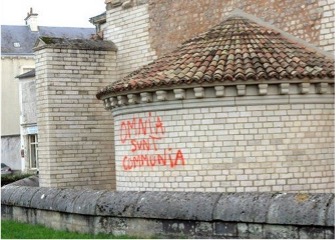
So, “rewrite the calendar” is said in another poem, brought into Bonney’s; perhaps “rewrite the calendar” is said in every poem, said in the fact, the (per)happening, of its saying. Di Prima’s missive speaks of an alternative (meta)physics (“laws of time & space / they never dream of”) and an alternative tradition, that of heresies, whispers, night gatherings, secret festivals, an assemblage of fragmentary and subterranean lineages that was one of her (and Bonney’s) long-standing devotions. At the heart of this discontinuous heretical tradition of “hidden religions” is a communist gnosis, the more-than-intuition that “‘in God all things are common,’” a phrase di Prima nestles within quotation marks precisely to show that it is a citable, living, ongoing anonymous undercurrent.[5] “All things are common” is communism’s pathos formula (Pathosformel), reverberating across all eras and shattering their calendars, making all times common. Heresy and communism both have to do with rewriting the calendar. Perhaps.
* * *
“All things are common” – omnia sunt communia – was the formulation in word and deed of Thomas Müntzer and the German peasant rebels in the year 1525.[6] They thought this year time would fold in on itself; they thought—and they lived as if—this would be the year that would dissolve all years. Müntzer’s name appears in Bonney’s writing occasionally, as in the last line of the poem “Razor Psalm,” from his “final book”[7] Our Death (2019): “This is a complaint on the state of the Bohemians. Thomas Müntzer. 1521 or something” (OD 16).[8] The “or something” hangs there to destabilize the calendrical fixity of the year. 1521 or something, or 2021, or something. Or 1525, 2025. This syntagm also suggests that the event so frailly registered under the proper name “Thomas Müntzer” marked the year 1521, or something else, some thing, some entity that is not a year.
The year 1525, as a communist conduit, appeared in Bonney’s book The Commons (published 2011, or something), alongside a mention of “a calendar”:
in the year 1525, strangling
coruscating wind of circles
here are your reasons
is a calendar, iatrogenic
or open to attack, yes,
on every level, your call
is important to us, mendicant[9]
This passage occurs in Part II of the book, which opens with a three-word line: “secret history number” (C 31). What are the secret histories of the numbers we live inside, are trapped inside? “You lived in rigged numbers,” the poem says just a few lines later.[10] This numerical con-job alludes to the hieroglyphics of value, the quasi-infinite stream of micro and macro transactions, trades, and logistical calculations that constitute and reproduce the immaterial architecture of the global economy: its algorithmic flow of inhuman data and commodities, occult accounting, and financial instruments that crush human sinew into numbers. But it also alludes to the years. The calendar is a haunted carousel of rigged numbers. This carousel is automated, and we are on it, and it is spinning much, much too fast: “The whiplash of the calendar is the quiet conversation of the commodity” (OD 58). What is a year? What year is this?
* * *
In his 1975 memoir of Walter Benjamin, Gershom Scholem recounts a conversation between the two young men that consumed an entire afternoon in 1916. It was on the peculiar topic of the ontology of years:
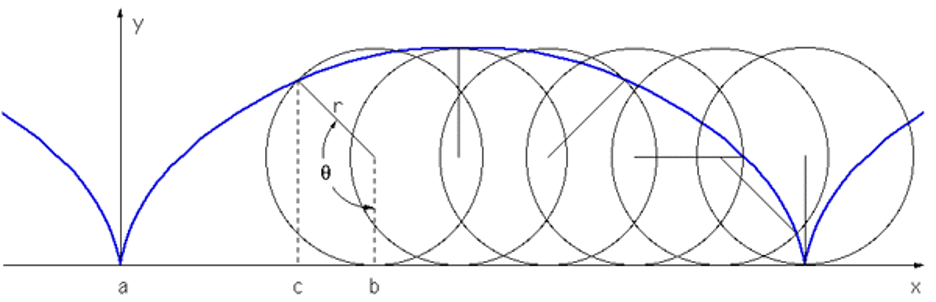
We discussed that subject for a whole afternoon, in connection with a difficult remark of [Benjamin’s] to the effect that the succession of the years could be counted [zählbar] but not numbered [numerierbar]. This led us to the significance of sequence [Ablauf],[11] number, series, direction. Did time, which surely was a sequence, have direction as well? I said that we had no way of knowing that time does not behave like certain curves that demonstrate a steady sequence at every point but have at no single point a tangent, that is, a determinable direction. We discussed the question whether years, like numbers, are interchangeable, just as they are numerable.[12]
Calendars give us a way of counting years; the calendar does not do the counting but assigns the mode thereof, and thus assigns each year its number in a certain sequence. But if years are not numerable, the calendar is an impossible creation, a forcing of order where there is none. In Scholem’s geometric analogy (perhaps more than an analogy) to a certain kind of topological curve (a cycloid, he suggests in his diary), time’s movement could still be plotted even if its future direction were unpredictable. But for Benjamin, there is no plot; a numbered year would refer always back to an impossible first that gives the beginning and an order to follow. At the origin, however, there is only a whirlpool, a vortex. We can count—counting may even reveal itself as something like a form of play, as in children’s games involving certain movements that are tagged to rhythms of counting up or down—but we cannot number the years.
What Scholem refers to as Benjamin’s “difficult remark” on the problem of marking historical time is written out in a mysterious fragment from that year (1916) called “Notes to a Study on the Category of Justice.” Benjamin’s comment occurs at the very end of this brief text, indicating that time-reckoning bears in essential ways on the question of justice and its relation to law (and to communism): “The problem of historical time is already presented in the original form of historical counting of time. Years are countable but in contrast to most countable things, cannot be numbered” [Das Problem der historischen Zeit ist bereits durch die eigentümliche Form der historischen Zeitrechnung gestellt. Die Jahre sind zählbar, aber zum Unterschied von den meisten Zählbaren, nicht numerierbar].[13] There is, then, a disagreement here between Benjamin and Scholem, one that remains somewhat obscure even though Scholem was perturbed enough by it to relitigate it fully sixty years later. But we may say that the dispute concerning the ontology of years was inseparable from another disagreement, one about a concept, and a word, a name, in a word, that, as suggested by Peter Fenves, was “shorthand” for “the problem of historical time”: Zion.[14]
Even more enigmatically, around this time, Benjamin wrote in a fragment: “Historical years are names.”[15]
This inquiry into the shape of time was an early preoccupation—in 1916 Benjamin was twenty-four years old, while Scholem was just nineteen—and it would persist until the end Benjamin’s “so brief life” (OD 15). Near the close of his final major work On the Concept of History, composed in 1940 under the shadow of fascism, genocide, desperate flight, and his own imminent death, Benjamin returns to the problem of reckoning time with a remark on the calendar and its relation to revolution. In Thesis XV, we read:
What characterizes revolutionary classes at their moment of action is the awareness that they are about to make the continuum of history explode. The Great Revolution introduced a new calendar. The initial day of a calendar presents history in time-lapse mode. And basically it is this same day that keeps recurring in the guise of holidays, which are days of remembrance [Tage des Eingedenkens]. Thus, calendars do not measure time the way clocks do.[16]
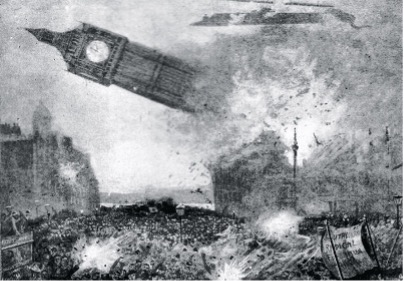
Clocks can be shot at, but calendars are harder to destroy.
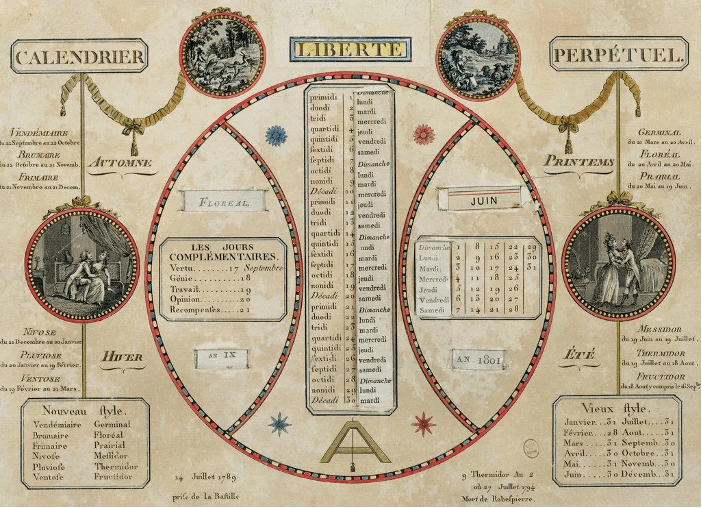
In this thesis, Benjamin is referring to the French Republican Calendar, that massive temporal overhaul that wiped the slate of history, and began time over at Year 1 with the declaration of the French Republic in 1792; this revolutionary calendar was not content to rewrite the counting of years, it also replaced the traditional names of the months with new ones like Germinal, Brumaire, and Thermidor, while altering the structure of the week, the hour, and the minute. While instituted by the Convention in 1793-4, this calendrical project was explicitly inspired by the pre-revolutionary texts of a fairly little-known philosopher and writer who, already in the 1780s, had dated his texts to “Year I” and proposed a new calendar stripped of the oppressing sediments of the centuries. The name of this time-rebel was Sylvain Maréchal.
* * *
What are years? Bonney: “The years are pebbles and they’re blocking my mouth. The years are coins each one stamped with a separable sun…The dreams are years are pebbles a system of inaudible suns.”[17] Each year is imprinted with a certain solar groove, becoming a pebble on our eyes and in our mouths, a coin whose exergue spells out a year and the inscrutable name of a sovereign. All our money has years scratched on it: a rigged number, promising us impossible passage. When the bough breaks, the descent is rapid, and Acheron’s undertow pulls the searcher deeper and deeper below the surface. Hegel says “Money is the self-propelling life of the dead,” reminding us that Pluto is the god of the dead and of wealth.[18] Bonney: “When the sun hits the earth it shatters into all human data, calendars of the places music goes when its notes disappear. The same places the dead live, I guess” (OD 118). Where the dead live? Where the dead live.
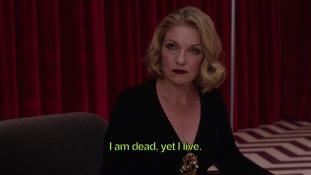
The dead live.[19] Our life. Our death. There are no maps to, or of, the land of the dead, no stars to navigate by, “no maps of the stars,” but only calendars (OD 121). The calendar is a measure of katabasis.
Years, dates, relentlessly punctuate Bonney’s writing, especially The Commons and the pamphlet Notes on Heresy (2001). These numbered years function both as traps, radii of enclosure, and as tiny holes perforating the wall of time, scratching open lines of flight. Sometimes certain years simply appear, alone or in a sequence, like a string of febrile code, a phalanx of ciphers. Others recur – like 1525, as we have seen, and 1649. On page 68 of The Commons, we read:
For some reason, it was 1649,
we were trapped inside it, clutching
our most reasonable point of view.
I can’t say more / vast territories
of our singing selves, decommissioned.
Maybe it was 2003, or something
1649…1525…2003 (or something)….what year is this? Somehow we are still “trapped inside” 1649, and other infernal, unfinal years and dates. The years turn, they curl and coil, but they do not pass. The years can be counted, but not numbered. They can, indeed, be rigged—and confined: “the years enclosed,” reads a phrase from his book Letters Against the Firmament (135).
Just as Bonney associates 1525 with Müntzer and the Peasants’ War, 1649 is linked with another early modern communist heretic in the poet’s anti-firmament: Abiezer Coppe.
Coppe, a so-called “Ranter” and antinomian preacher in seventeenth-century London, surfaces in Notes on Heresy delivering a piece of “avant-garde” performance art in 1649—“the year the king was executed,” Bonney notices; also the year of the Diggers’ communist experiment and Gerrard Winstanley declaring the whole earth “a common treasury”—consisting of an hour long sermon entirely composed of swearing.[20] Coppe materialized as a voice in the kairotic vortex of chaos opened by the English Civil War and the beheading of Charles I, leaving behind only strange anecdotes and stranger apocalyptic visions, like A fiery flying roll: a word from the Lord to all the great ones of the Earth, whom this may concerne: being the last warning piece at the dreadfull day of judgement (1649), a bracing millenarian cry for the coming of revolutionary upheaval and communism, of omnia sunt communia, “all things common”: “Cast all into the Treasury, &c. Account nothing thine own, have all things in common,” he writes.[21] His divine ire was trained ruthlessly upon the rich; his favored symbol, the historian Peter Linebaugh tells us, was the sickle.[22]
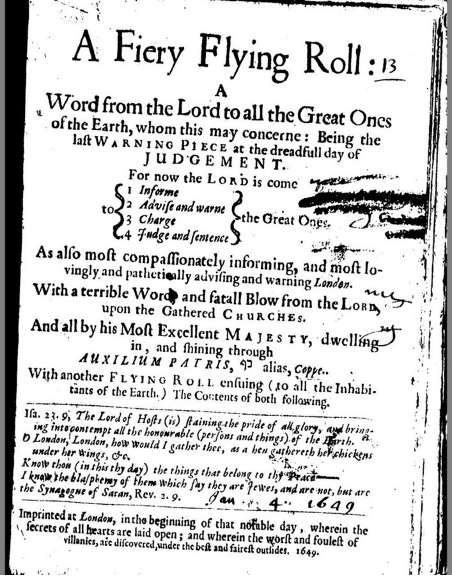
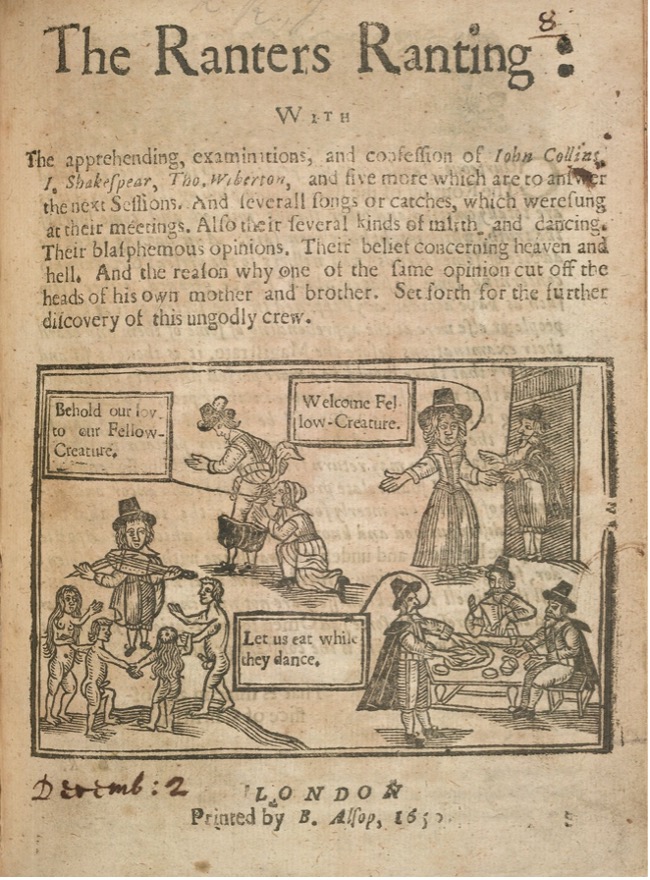
Coppe appears recurringly in Bonney’s later writings, brandished like a talisman. One such key moment sees Coppe invoked near the end of “Corpus Hermeticum: On the Revolutions of the Heavenly Spheres,” that is, just before the “ACAB: Nursery Rhyme” that concludes that poetic sequence. But in between the naming of Coppe and the start of the jagged lullaby “For ‘I love you’ say fuck the police,’” we have another date, one that inscribes the police ontology of the calendar:
Check the extent of police lines. 1829, Robert Peel invented 1000 pigs to circle the city as walls or gates as cordons. This happened. Those 1000 pigs as calendar, the working day a pyramid as razor the police recuperation of the sun. It was dark and the barricades were burning. (L 28)
Robert Peel founded the Metropolitan Police at Scotland Yard in 1829. What year is this? What is this year? Can we know? How could we, when the cops themselves compose the calendar, literally: “Those 1000 pigs as calendar.” This did happen. It is happening again.
Though he doesn’t mention it, we can imagine Bonney was interested in the homophonic proximity of Coppe and cop, only the silent letters pe differentiating the prophet from the pigs, as if the name Coppe, by some inverse charm that neutralizes a spell precisely by saying it slant and intending a silent letter, could ward off the wardens of time. The silent, infinitesimal difference between Coppe and cop cannot be said, but it can be screamed: “a silent musical fixture separates a human being from a cop.”[23] So much of Bonney’s concerns, so much of his poetics, is summed up in this disturbing sonic coincidence, this silent differentiation. “Everything is made of cops,” he says (OD 111). Especially calendars. Perhaps.
* * *
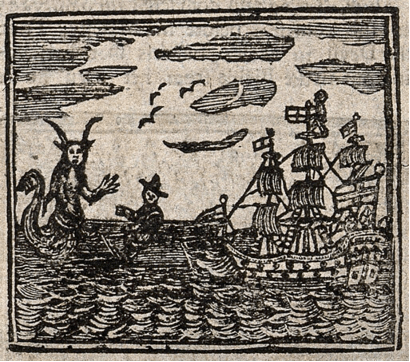
In Bonney’s Notes on Heresy, Coppe appears alongside Ann Baites of Morpeth, a woman accused of witchcraft in the seventeenth century. Baites is said to have ridden around the land on an eggshell performing anarchic mischief. Witches were frequently thought to use egg shells consumed on March 1st as vehicles to travel by sea or land, hence the apotropaic folk tradition of breaking eggs on this specific day, for only eggs from March 1st could be detourned by black magic. March 1st (or another day in mid-March), bringing spring, is traditionally, from the earliest Roman calendars until the consolidation of the Gregorian calendar in early modernity, the first day of the new year. “don’t say ‘happy new year’ say fuck the police.”
Still, in Bonney’s cosmos, every year is 1649, is 1871, is the Year II: “I feel like it’s gonna be the 6th August 2011 for ever. Christ, for all I know it’s still 13th October 1925” (L 39). October 13th, 1925 is the day of Margaret Thatcher’s birth.
In a particularly forlorn moment in the deeply forlorn book Our Death, we read: “What if this year never ends” (87).
* * *
Calendars skulk and stalk about everywhere in Bonney’s hermetic corpus. It is as if the calendar provides the most apt entry point into the “nightmare metaphysics” (Alice Notley) of our time, which is to say our death. The calendar appears as a kind of registry and regulation of the senses—Bonney speaks of “The blank statistics of the calendar” and “the sensory calendar,” invoking Marx’s formulations about the historicity, captivity, and possible emancipation of the senses (alongside Rimbaud’s “derangement of the senses”) (OD 88), and he writes of a calendar being constantly altered and constantly “normalized” by the archons: “The angles of the calendar are altered every morning and by evening it has all become normalized” (OD 115).
This comes to a head in the unforgettable poem “From Deep Darkness,” the second in the titular sequence of Our Death, which takes the form of an eschatological will and testament delivered in a psychedelic daze following five straight days without sleep. After leaving various personal effects and impersonal affects to friends and enemies alike, the poet bequeaths his “sensory system” to a dark lunar recipient, remarking on how his five senses seem to swerve “in and out of calendrical time” like anonymous interdimensional birds. This prompts a reflection on the connection of the five senses to the Mayan calendar, by way of Afro-surrealist Gnostic poet Will Alexander:
after five days without sleep your heart gets into some fairly interesting unknowable rhythms and your connections with the earth and its five senses become increasingly tenuous and I think at this point of Will Alexander’s essay “A Note on the Ghost Dimension,” I don’t know if you’ve read it, he writes in it somewhere about the missing five days of the Mayan calendar, which apparently is a time when monsters and poisons will appear, and I don’t know much about the Mayan calendar, but after five days without sleep I know a lot about ghosts and monsters and poisons, and a lot about how the missing five days could be taken to mean the fate of the five senses themselves, and how those missing five senses have been kidnapped and held for no ransom on some irrelevant island deep within the center of some capitalist astrological system. (OD 68-69)
Remember 2012, when everyone freaked out about the apocalypse supposedly predicted by the Mayan calendar on a certain date, 12/21/2012 or something? But the doomsday discourse of 2012, with its fervid astrological projections, neglected the most important configuration of all, the one we remain trapped in: the “capitalist astrological system.” Bonney, following Alexander (who takes up the Mayan Calendar in other works), zeroes in not on a specific date of apocalypse but on the “missing five days,” the days that slip in and out of calendrical time, since the Mesoamerican calendar registers a year of 360 days (18 months of 20 days). The five un(ac)counted days filling out the solar year are named the “nameless days,” five days of terrible calamity and ill omens, comprising the tenebrous mini-month known as Wayeb (sometimes spelled Uayeb). Nefarious days. Apocalypses do happen. Ask the Maya. Ask Gerald Horne.

* * *
Bonney took a great interest, I am told, in the vast project of rewriting the calendar during the French Revolution. It so happens that the newly instituted French Republican Calendar also had a problem with five extraneous days. Among its many transformations, such as freshly rebaptized months and new festivals, the novel calendar had abolished the traditional seven-day week and introduced ten-day cycles called décades, with 36 décades comprising a year. 36 x 10 = 360: five missing days. To these five days (six in a leap year) Fabre d’Églantine, one of the leaders of reformatting the calendar, bestowed the name “Sansculottides,” and they became intercalary feast days, holidays to celebrate the revolution. The fifth and final Sansculottide, D’Églantine declared, would give rise to a festival of upheaval and the radical mocking of the law, birthing “a new kind of tribunal, at once gay and terrible” (“Ici s’élève un tribunal d’une espèce nouvelle, et tout à la fois gaie et terrible”).[24]
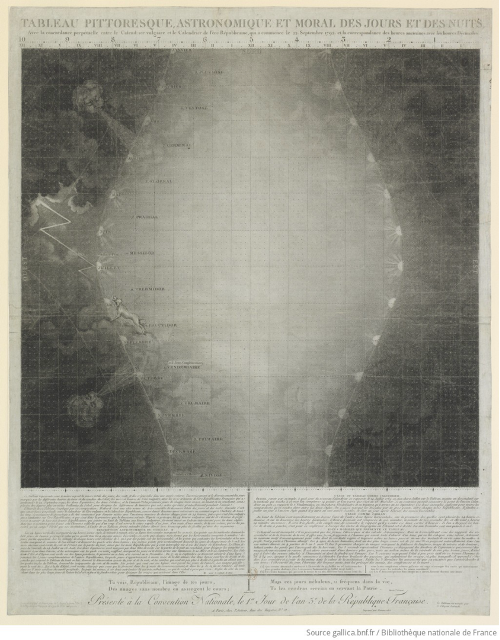
The sans-culottes were the energized proto-proletarian masses, the most radical, most anti-property faction of the many competing forces in the maelstrom of the early French Revolution. D’Eglantine’s decision in 1793 (Year II) to name the five epagomenic days after the sans-culottes was a bold attempt to keep this time out of time, to preserve an insurrectionary and egalitarian flame in them, by naming the limit-days of the revolutionary calendar after the revolution’s own most radical horizon. The insurrectionary calendrical energy channeled by the Sansculottide days was not lost on the Revolution’s katechontic watchmen, who attempted to rein in this dissolutive force in the counter-revolutionary lurch of 1795, which established the Directory and produced a new constitution that de-radicalized the Jacobin one of 1793, shoring up the sanctity of property and excising the mentions of the common and the sacred right of insurrection. Another part of this 1795 rearguard action accompanying the new constitution was to remove the name Sansculottides for the five festival days, instead renaming them the anodyne jours complémentaires (complementary days). In this way, the dangerous supplement of the calendar became the contented complement. The five “nameless days,” then.
If years are names, what are days?
In addition to the five intercalary days, an even bigger glitch—a kind of temporal parallax—in the new calendar of the French Revolution was the décalage between the overthrow of the monarchy on August 10th, 1792, and the start of the National Convention and the declaration of the Republic on September 22nd, 1792 (also the autumn equinox, a coincidence highly favored by one of the calendar’s engineers, Gilbert Romme). As Sanja Perović writes in her remarkable book on the French Revolution’s calendar, there was
a curious lag time between the end of the old world and the beginning of the new…This implied that the time between 10 August and 22 September 1792 belonged neither to the past…nor to the new time of the Republic that had to wait until the solar equinox in order to be consecrated by nature. Although heralded by the revolutionaries themselves as the beginning of a new time, the events of these hot summer weeks were nonetheless condemned to remain outside the chronology established by the new calendar.
…
The Republican calendar thus originated from two different sources: the historical violence that brought about the rupture of 10 August and the natural or ‘utopian’ time that heralded the birth of the new Republic on 22 September. The former was symbolized by the spontaneous proclamation of a new linear chronology starting from Year I; the latter by a return to the cyclical and astronomical time of nature.[25]
We could think of the French Republican Calendar, an impossible attempt to recommence time and institutionalize rupture, to rig numbers in favor of revolution, as riven in two. Between these two origins, between these two conceptions of time, between August 10th and September 22nd 1792, are the nameless days of zero. Zero time. Perhaps say: rewrite the calendar.
* * *
Bonney, too, speaks of a cracked calendar, “split down the middle”:
Who was it, maybe Raoul Vaneigem, who wrote something about how we are trapped between two worlds, one that we do not accept, and one that does not exist. It’s exactly right. One way I’ve been thinking about it is this: the calendar, as map, has been split down the middle, into two chronologies, two orbits, and they are locked in an endless spinning antagonism, where the dead are what tend to come to life, and the living are, well you get the picture. Obviously, only one of these orbits is visible at any one time and, equally obviously, the opposite is also true. It’s as if there were two parallel time tracks, or maybe not so much parallel as actually superimposed on each other. You’ve got one track, call it antagonistic time, revolutionary time, the time of the dead, whatever, and it’s packed with unfinished events: the Paris Commune, Orgreave, the Mau Mau rebellion. There are any number of examples, counter-earths, clusters of ideas and energies and metaphors that refuse to die, but are alive precisely nowhere. And then there is standard time, normative time, a chain of completed triumphs, a net of monuments, dead labour, capital. The TV schedules, basically. And when a sub-rhythmic jolt, call it anything, misalignment of the planets, radioactive catastrophe, even a particularly brutal piece of legislation, brings about a sudden alignment of revolutionary and normative time, as in the brute emergence of unfinished time into their world, it creates a buckling in its grounding metaphor, wherein that metaphor, to again misuse Hölderlin, becomes a network of forces, places of intersection, places of divergence, moments when everything is up for grabs. Well, that’s the theory. (L 116-117)
There is class struggle, in fact, cosmic struggle, internal to the structure of the calendar. What Bonney names “poetics” is his attempt to attune to and inhabit the antagonistic time of the dead, to align with its riven rhythm. As he writes elsewhere: “there is class struggle among the dead as well.”[26] Calendars are written, and rewritten, as poems are, built from the ruins of “unfinished time.”
* * *
“Yet the five empty days of calendar of the Maya persist in my vision,” writes Will Alexander in “A Note on the Ghost Dimension,” these “[d]ays when monsters appeared, when nights reversed and people hovered in a poisonous neutrality.”[27] Ancient Mayan calendrical measures of time like the baktun, the katun, and the tzolkin surface elsewhere in Alexander’s work, like the long epic poem The Combustion Cycle (2021), where he calls them “subtle metrics” and “numerous voids.” The Maya and the French Revolutionaries were not the only ones to have an ordinary calendrical year of 360 days, with 5 remnants: a hand’s full of special, spectral, uncanny days. The Ancient Egyptian calendar was also divided this way. According to Plutarch, a curse was placed by the Sun upon the goddess Nut (Rhea) that barred her from bearing children on any day of the year. But Thoth, in order to help out Nut, won a gamble with the moon that allowed him borrow fragments of her light. From these shards of moonlight, Thoth, who Plutarch calls Hermes (transposing Egyptian deities to the Greek pantheon[28]), assembled five new days not governed by the curse, and on these loophole days the gods were born. The special intercalary month of moon-days thus celebrates this cradle of time, and yet these 5 days were also thought hazardous.
Will Alexander’s “A Note on the Ghost Dimension,” the essay discussed by Bonney in “From Deep Darkness,” resurfaces in the title of another poem from the eponymous sequence in Our Death. The 28th and final poem in the sequence proper is simply called: “The Ghost Dimension.” The ghost dimension—where the dead live? It is brief, and reads as follows:
We don’t know their names or their faces. They are gathered in ruined houses, in water-damaged pictures. They are not our gods, our hypocrisy, your chastity. Who are you anyway. What are these cities consumed by the winds. Theirs is not your glitter. It is not their stars that encircle these walls where cold and evil bastards are building something hungry. Their names are very different. We use them, those names. New uses for gravity. Methodologies of the wrong apocalypse. (OD 100)
A new use for gravity would augur another order of descent, a chthonic physics of downrising that moves through the vortices of time, the latticework of years. New uses for time and space, broken laws they never dream of. What questions would lead us to the edge of the wrong revelation?
* * *
“Whatever’s missing will be here by spring. / you can date it.” -Bonney, “Mayday” (Blade 7).
* * *
May Day: first day of the fifth month. 5 is an important number for Bonney.[29] There are the five senses (are there only five?), whose historical formation, following the young Marx, he casts as a “cut…in the sensory calendar”; there are the five vowels in the alphabet; five so-called centuries of capitalism; and of course there are the five missing days of the calendar.
The Caribbean intellectual Sylvia Wynter, who, like Bonney, draws much from the early Marx’s writing on the senses, composed the drama Maskarade (1973), which involves a kind of play-within-a-play. The main plot of Maskarade takes up the staging of the Jonkonnu festival in the years immediately following emancipation in Jamaica (1840s). Jonkonnu, a syncretic festival emerging from the culture of the enslaved and celebrated in the Caribbean since at least the early eighteenth-century, is at the very heart of Wynter’s thought. In addition to Maskarade, her unpublished 900-page magnum opus Black Metamorphosis generates many of its core insights out of an extensive engagement with the history and practices of Jonkonnu. For Wynter, the festival, which usually takes place around Christmas and ushers in the new year, harbors deeply subversive energies that feed into slave rebellion, while also harboring a vision of collective subsistence that negates the entire system of private property. Formed out of fragmentary esoteric knowledge kept alive by agricultural rituals, secret societies, and cults transmitted from Africa, this festive practice was transformed (“transplanted” and “transhipped” are her words) by the abyssal travel across the Atlantic and entry into the “nightmare reality” of slavery. In the subversive festival Jonkonnu, there is “an alternate way of thought,” where (she quotes Marx) “senses become theoreticians”[30]; for Wynter, the festal and exilic rite names the matrix that gave rise to Black music in the New World, including blues and jazz. At its most far-reaching, Jonkonnu activates black revolt and adumbrates the promise for a communism of the earth and the genesis of a new species (being). This is most visible in the lyrical sequence towards the end of Maskarade, where the two storyteller characters Lovey and Boy offer a visionary proclamation of all things common patterned to the rhythm of the earth (“share my earth in common!”), presaging the ruins of empires (“a time will come…their rule will pass. Like Rome pass”) and the sharing of life. This experience is linked to the messianic festival time, which is incarnated in five days that do not belong to the calendar:
BOY: And as the rhythm step, the rhythm say:
Share! Share my earth in common!
…
LOVEY: Wait until the edges
Of the year have met
When three hundred and sixty days
Of ordinary time pass and gone.
Then the time that mark
By the wax and wane of the moon
Appear at last!
The five feast days
That are out of time
The holy days, the maskarade time.
BOY: Ordinary time reverse!
Power uncrown! The king dethrone!
Number one out for the count.
The Queen Mother rule in.[31]
Once again the five days. The 360 days, ordinary time, are the days of property, the days of the first person, the I, who is “number one.” In these days, one thing follows another in the succession of proper order, according to the sovereign’s (ac)counting. But the “the five feast days / that are out of time” bore holes in the calendrical year, what Bonney calls “holes the length of the calendar”—this is the time out of time where sovereignty is destituted (“the king dethrone!”) and the one, the first, the archē, does not (begin the) count: “Number one out for the count.” It is the time of zero. It is also the kairotic time that moves along a lunar curve, “by the wax and wane of the moon.” The mask of blackness, the mask of anarchy, the mask of time. Maskarade time.
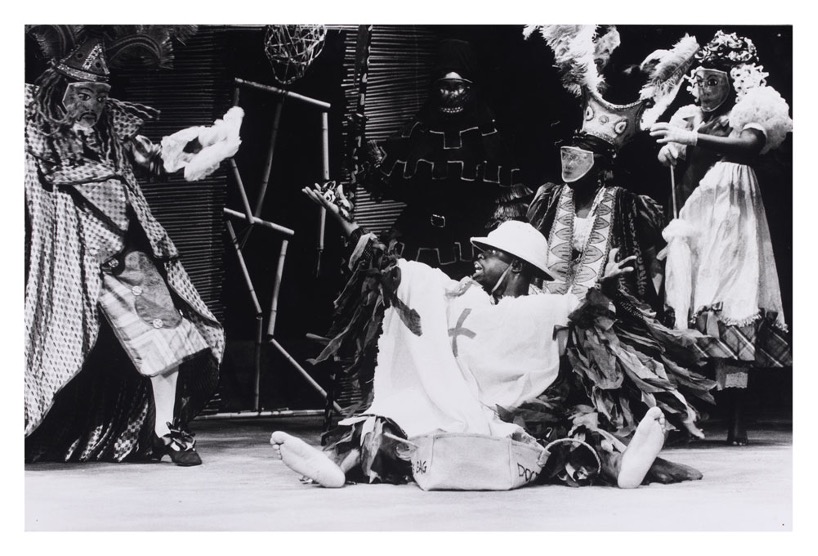
As Édouard Glissant wrote about the burden of time in the Caribbean: “Memory in our works is not a calendar memory; our experience of time does not keep company with the rhythms of month and year alone.”[32] For Wynter, the dream of the new year’s Jonkonnu is a revolutionary festive communism that rewrites the calendar and rewrites time. The “Queen Mother” reigning here is not a new sovereign, but simply the earth as the end of all royalty and all sovereignty. In a prefatory interview published with Maskarade, Wynter revealed that the character Gatha (whose name suggests both “Gaia” and “gather”) is meant to embody “Mother Earth.”
* * *
Because “the Caribbean notion of time was fixed in the void of an imposed non-history,” according to Glissant, “the writer must contribute to constituting its tormented chronology.”[33] This is no less true of revolutions and revolutionaries. While much attention is paid to the French Republican Calendar that reset time to Year 1 in the 1790s, the fact that the Haitian revolutionaries did the same is almost completely ignored, even by scholars of the latter revolution. The heading of the first official document of the new state of Haiti, its Declaration of Independence, read aloud by rebel general turned sovereign Jean-Jacques Dessalines on January 1st, 1804 (don’t say happy new year), gives both the date on the Gregorian calendar and is dated to “Year 1 of Independence.”
Less an homage to the French Revolution than a reckoning of the work of starting time over again, a recognition of the radicality of slave revolution in the New World, a claim to superseding even the reset of time that the French Revolution claimed for itself—the Haitian Revolution counted time back down to zero, displacing both the Gregorian and the French Republican calendars along with their chronologies of torment. Sure enough, the Haitian Constitution of the following year is dated officially to “May 20, Year II,” marking an even deeper rupture with the recent cleavage in history in Europe.
The Haitian Revolution, which erupted in 1791 after a secret Vodoun ceremony performed by enslaved conspirators in the moonlit woods, drew on energies that Wynter explicitly connects to Jonkonnu and the secret societies and “revolutionary cults” that transmitted it (Black Metamorphosis 121, 538). We are still far from understanding the depth of the kinship between magic and revolution.[34] The Haitian Declaration of Independence, composed after the French troops sent by Napoleon Bonaparte to re-establish slavery were finally expelled, enshrines a cosmic war against colonialism, slavery, and their representatives. As the Declaration promises: “Peace to our neighbors, but anathema to the French name, eternal hatred to france: that is our cry [haine éternelle à la france: voilà notre cri].”
What does it mean to found a polity on “anathema” and “eternal hatred”? What kind of eternity is this? Perhaps it is in fact the most honest thing upon which to found a state—for it does not occlude the civil war (stasis, linked etymology to “state,” stare, to stand, cf. Greek histemi) that every state otherwise claims to have overcome—thus leaving bare the cosmic antagonism, the violence at every state’s founding, rather than obscuring and occluding it while monopolizing violence. Here, the state bears its birth scar, as a curse—eternal hatred, war unending, til it end the world and itself.
* * *
The moon bears an essential and originary relation to the very word “calendar.” Calendar derives from the Latin verb calare, meaning “to call,” so named for the tradition of the Roman pontifex “calling out” the new moon from the top of the Capitoline Hill, thus announcing the first day of the month and setting the schedule for the feasts and festivals to come. On this first day of the month, called the kalends, interest on debts came due—hence a kalendarium, in Latin, was the term for a financial accounting book, a book of debts. Time and money. The calendar’s origin in the West is, therefore, intimately related to financial transactions: the “rigged numbers” we live inside are also debts. When Bonney wonders aloud about a lunar Marxism—“I think a little about the moon, its relation to Marxism” (OD 103)—it is precisely this connection between money and the lunar cycle that he intuits. The fact that, through the calendar, the priests regulate the flows of captured time called debt is also revealing, for as Benjamin points out after Nietzsche, debt and guilt form a political-theological complex (in German, Schuld means both debt and guilt) that coheres the temporal structure of worldly authority—that even ratifies the authority and directionality of time itself. In an early fragment, Benjamin writes: “In world history everything takes place in time (temporal revolutions, temporal judgments of the nations)[.] In order to guarantee the unidirectionality [Einsinnigkeit] of occurrence, the highest category of world history is guilt-debt [Schuld]. Every world-historical moment is inculpated and inculpating.”[35]
But the calendar is not just the tolling of debt-time; as its etymology of “calling” suggests, it is something essentially related to vocalization, a call, a cry. The priestly voice calls from high upon the imperial hill, but perhaps not only from there. Perhaps there is also a calendar under the hill, a calendar from below, bellowed out in a collective voice, what Bonney calls a “counter-calendar” (OD 91). What would this counter-calendar that dispenses with the vertical hierarchy of the hill look like? What are its immanent poetics? What would it mean to follow this anonymous calendar from the plebeians and proletarians, from the slaves? Down below, where the dead live. Amiri Baraka, subject of Bonney’s PhD thesis, asks and answers: “what is a slave, a dead life.”[36] Perhaps this would be a heretical jubilee calendar, one that keeps the calendrical account book (the calendar and the kalendarium) at zero and spreads zero around. Jubilee, or revolution, would mean the concerted dispersal of zero. Zero is the passage that conjoins the living and the dead.
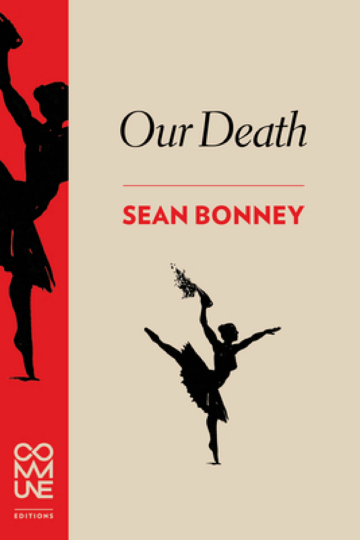
Although right now “we are far from the moon,” as Bonney writes, such a dispersal would call forth an utterly different relation to the moon (and, perhaps, to Marxism) (OD 103). If we return to the di Prima poem from the outset, with its revolutionary invitation to “rewrite the calendar,” the contours of this other connection to the moon begin to become visible: “secret celebration of ancient season feasts & moons. / Rewrite the calendar.” In the festival of revolt, reassembled moonlight ladles new days. The calendar calls, summoning us to new celebrations of ancient feasts and selenic hymns, calling us to dance in this unruly, moonlit field, a “zero field” (Will Alexander), a calendar turned into a cluster of Molotov ballerinas dancing on the moon: “the calendar of British incidents becomes transformed over and again into a posse of burning ballerinas advancing on the city across the landscape of some kind of scorched moon” (OD 72). The moon, heretical counterpart to the sun’s brutal panoptic transparency, is locked in an evasive dance with that yellow eyeball Bonney speaks of as the “solar cop” (OD 78).
A prayer toward the moon: forgive us our debts, now and at the hour of…Our Death.
What is a year? A revolution. A year is a revolution around “the sun, that solar bastard” (OD 96). Who, after all, is the enemy of the sun? A question for Samih Al-Qasim and George Jackson. May we earn the right to call them, and Bonney, our dead. The poet’s partisan calendrics insist upon unsettlement: “Most mornings you’ll settle for nothing less than the obliteration of the sun” (OD 78).
[1] Sean Bonney, Letters Against the Firmament (London: Enitharmon, 2015), 29. Hereafter cited as L.
[2] “[T]he sky closes and the calm night begins, but still it leaves us feeling cold. The calendar, that particularly esoteric version of music, was invented as a means of warding off the fear associated with that cold.” Sean Bonney, Our Death (Oakland: Commune Editions, 2019), 110. Hereafter cited as OD.
[3] Christina Chalmers, “The Involution of the Storm Corner: Sean Bonney’s Occult,” Journal of British and Irish Innovative Poetry 14:1 (2022): 3-4.
[4] Diane di Prima, Revolutionary Letters (San Francisco: Last Gasp, 2007), 76. The imperative to “rewrite the calendar” is echoed a few poems later in “Revolutionary Letter #62”: “LET’S REWRITE / the history books. / History repeats itself / only if we let it,” Revolutionary Letters, 79.
[5] David Stephen Calonne, Diane Di Prima: Visionary Poetics and the Hidden Religions (2020).
[6] O. L. Silverman, “Political Theory and the Peasants’ War,” History of the Present 15:1 (April 2025).
[7] “These days everyone’s writing their final book” (OD 79).
[8] This is echoed in an unpublished poem “Letter Against the Firmament” from Bonney’s blog: “If I feel solidarity with anything at all, its simply with the forces of namelessness and invisibility, as if my body was less an ordered system of molecules and more a negative community of shattered, cannibalistic and stupid sub-atomic particles, and some of those particles are mine and some of them are not, as if my body had become an anti-linear intersection point where hail and domestic locusts had somehow mingled with the original recitation of Thomas Müntzer’s ‘Protest About the Condition of the Bohemians’ – that would be 1521, something like that –.” https://abandonedbuildings.blogspot.com/2014/09/letter-against-firmament.html
[9] Sean Bonney, The Commons (London: Openned Press, 2011), 47. Hereafter C.
[10] Notably, this was changed to “rigged integers” in the version excerpted in Letters Against the Firmament.
[11] In a poem in Our Death, Bonney associates “sequence” with the “calendar”: “‘Defeat is among us, and war, and prophecy.’ That’s a line from Muriel Rukeyser. I was thinking about it a couple of days ago, asking myself whether the words followed a sequence, or whether they could only be taken simultaneously. That is, were they like marks on a calendar, or were they a kind of cacophony” (OD 88).
[12] Gershom Scholem, Walter Benjamin: The Story of a Friendship, trans. Harry Zohn (New York: NYRB, 1981), 41.
[13] Walter Benjamin, “Notes Toward a Study on the Category of Justice,” trans. Eric Jacobson, in Eric Jacobson, Metaphysics of the Profane (New York: Columbia University Press, 2003), 166-169.
[14] Peter Fenves, “The Mathematical Messiah: Benjamin and Scholem in the Summer of 1916,” Reflexão, 33: 94 (2008), 167.
[15] Quoted in Fenves, 169.
[16] Walter Benjamin, “On the Concept of History,” in Selected Writings, vol. 4, Trans. Edmund Jephcott et. al., ed. Howard Eiland and Michael W. Jennings (Cambridge: Harvard University Press, 2006), 395.
[17] “Poems After Katerina Gogou” https://abandonedbuildings.blogspot.com/2015/09/poems-after-katerina-gogou.html
[18] G.W.F. Hegel, System of Ethical Life and First Philosophy of Spirit, trans. H.S. Harris (Albany: SUNY Press 1979), 249 (translation modified). It is worth noting that the Bonney’s collection All This Burning Earth concludes with a passage from a letter written in 1795 by the poet Friedrich Hölderlin to Hegel: “But for you it would be something of a duty in that you could perform in Tübingen the role of a waker of the dead. It is true that the Tübingen gravediggers would do their utmost against you.”
[19] In 1999 Bonney wrote a chapbook, recently republished by Veer Books in 2024, entitled from the book of living or dying. The final page of this text offers verse and poetry studded with dates: “cries punctuate their silent night / and discuss their jobs. 1492. ledgers, part-timers, as yet uncrystalised, 1733, they are still in the office, chewing opals for they have no teeth, 1918, allegedly they are still in a meeting…as a door opens in the disjunctions of mathematics, 1946, the imposition of absolute vertigo.”
[20] Sean Bonney, Blade Pitch Control Unit (Cambridge: Salt, 2005), 45. Hereafter Blade.
[21] Abiezer Coppe, Selected Writings (London: Aporia Press, 1987), 54.
[22] Peter Linebaugh, “Fiery Flying Roll,” Counterpunch (Jan 2023). https://www.counterpunch.org/2023/01/13/fiery-flying-roll/
[23] “Robert Peel still peers down from Broadgate wall and is a blockade, Newgate torched. Police moved in smashed heads in counter-time, a silent musical fixture separates a human being from a cop” (L 28).
[24] “Rapport sur le calendrier républicain” https://fr.wikisource.org/wiki/Rapport_sur_le_calendrier_r%C3%A9publicain
[25] Sanja Perović, The Calendar in the French Revolution: Perceptions of Time in Literature, Culture, Politics (Cambridge: Cambridge University Press, 2012), 88; 124-125.
[26] Sean Bonney, “Notes on Militant Poetics,” 14.
[27] Will Alexander, Singing in Magnetic Hoofbeat: Essays, Prose Texts, Interviews and a Lecture, 1991-2007 (Ithaca: Essay Press, 2012), 23. Alexander continues: “Popular astrology is misleading. Yet the five empty days on the calendar of the Maya persist in my vision. Days when monsters appeared, when nights reversed and people hovered in a poisonous neutrality. Let’s say it like this. Our bodies are invisible documents because our language continues tracing those other stellar locales where we invisibly glide to other galactic possibilities far beyond the suicidal repartee which the American tenor so fitfully engages. In twenty billion years a new sun will be forming, with green light burning beyond human debate. Only a vatic recitation can overcome rehearsals for destruction.”
[28] It is worth paying attention to the appearance of Egyptian Hermes here, given the fact that we began with Bonney’s poem entitled “Corpus Hermeticum.”
[29] There are many more examples, but consider:
“Five points on the map. Five days
You watch your city burn.
Five am. Five cops at the door.
Interpret that. No city is built again
Your map a declaration, a trap, a war” (OD 38).
“Would the five invisible people who are gathered round my bed please give me an explanation” (OD 29).
[30] Sylvia Wynter, Black Metamorphosis, unpublished ms, 109.
[31] Sylvia Wynter, Maskarade, in Mixed Company: Three Early Jamaican Plays, ed. Yvonne Brewster (London: Oberon, 2012), 103.
[32] Édouard Glissant, Poetics of Relation, trans. Betsy Wing (Ann Arbor: University of Michigan Press, 1997), 72.
[33] Édouard Glissant, Caribbean Discourse: Selected Essays, trans. J. Michael Dash (Charlottesville: University Press of Virginia, 1989), 65.
[34] Areïon, Warling, Howling, Pure (Contagion Press, 2024).
[35] Walter Benjamin, Toward The Critique of Violence, ed. Peter Fenves and Julia Ng (Stanford: Stanford University Press, 2021), 74. This theme of debt-guilt is also taken up in Benjamin’s fragment “Capitalism as Religion.” As opposed to dispersing zero (jubilee), for Benjamin, capital disperses guilt.
[36] Amiri Baraka, The LeRoi Jones / Amiri Baraka Reader, ed. William J. Harris (New York: Basic Books, 2009), 562.

