Alessandro Sbordoni
Alessandro Sbordoni was born in Cagliari in 1995. He is the author of Semiotics of the End: Essays on Capitalism and the Apocalypse and The Shadow of Being: Symbolic / Diabolic. He is an Editor of the British magazine Blue Labyrinths and the Italian magazine Charta Sporca. He lives in London.
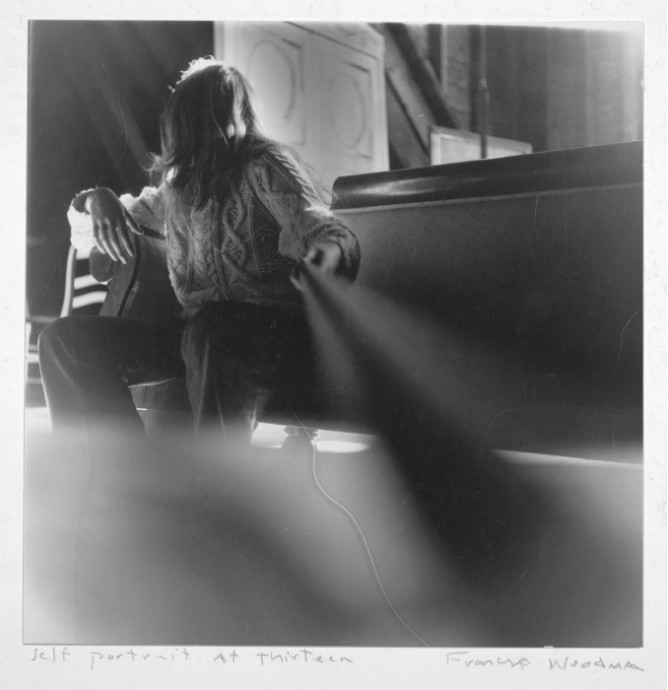
“Francesca Woodman knew how to vanish,” writes Brian Dillon in his short essay about the oeuvre of the American photographer. In Francesca Woodman’s first self-portrait at the age of thirteen, the artist photographs herself as she turns towards and away from the image, like another critic aptly remarked: her left hand operates the shutter release remotely while her head looks in the other direction. She is both inside and outside of the image, interior and exterior to the artwork.
Between 1972 and 1982, Francesca Woodman represented her own metamorphosis in hundreds of black-and-white photographs: her white and naked body twisted around a basket of eels, under the dark roots of a tree, or behind the wallpaper sheets. In her self-portraits, Francesca Woodman is transformed: from the photographer herself to the photograph, from the living subject to the phantomatic object of the image. “Am I in the picture? Am I getting in or out of it?” she writes in her journal. “I could be a ghost, an animal or a dead body…”
Photography, as much as art in general, is a relation with death. The etymology of the word image is derived from the Latin imago, the funerary mask of Ancient Roman aristocrats. Death, to paraphrase Roland Barthes’ Camera Lucida, is the second nature of photography. The photography of Francesca Woodman is also drawn to death: from the settings (graveyards, abandoned houses, and so on) to the representation of ghostly images by means of slow shutter speeds and double exposures. In her self-portraits, the photographer disappears in order to stage her own death.
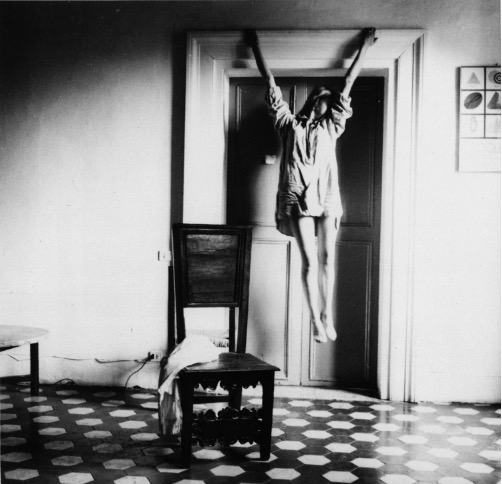
The metamorphosis into an image is always a kind of demise. When Gregor Samsa wakes up one morning from restless dreams, he finds himself transformed into a giant insect. Gregor Samsa “himself” is no longer alive. But the insect itself has attained the last stage of its metamorphosis, what entomologists call the imago. In contrast with Franz Kafka’s vermin, Francesca Woodman metamorphoses into whatever is in front of the camera frame. Thus, in one black-and-white photograph, for example, she hangs from a doorframe in the same way as a white cloth hangs from a chair in the foreground. In another photograph, Untitled, Providence, Rhode Island, 1976, she sits in front of the shadow left by her body onto the white-dusted floor. Francesca Woodman is no longer other than her own image, but then she is not “herself” either.
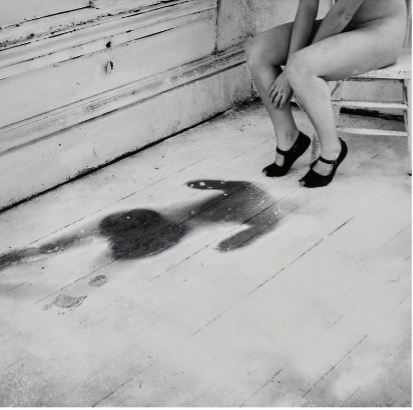
In his commentary on The Metamorphosis, Maurice Blanchot writes about art in terms of the mastery of death and the pleasure that follows. This is no more apparent in Franz Kafka’s Diaries than in Francesca Woodman’s oeuvre. In a short film documenting the aforementioned photograph shot in Rhode Island, the American photographer exclaims: “The beautiful shade! Oh, I’m really pleased!”
In an entry from his Diaries, Franz Kafka writes that his best writing is the one he did when he would have died with a smile. The artist is, to develop Maurice Blanchot’s argument about literature, the one who makes art “in order to be able to die.” And yet, paradoxically, the power to make art “comes from an anticipated relation with death.”
In Francesca Woodman’s photography, nothing survives the image except as a ghost. In her so-called “ghost pictures” from 1976, the body of the artist is blurred with long exposure times and soft focus. It becomes altogether part of the background and the foreground. The body is more or less bound to invisibility. The artist, then, returns like a specter who lost its material body but not its immaterial form, both appearing and disappearing on the gelatin silver print. In such works, the photographer’s position with regard to the camera lens is unknown. “You cannot see me from where I look at myself,” a critic once said about one of her self-portraits.
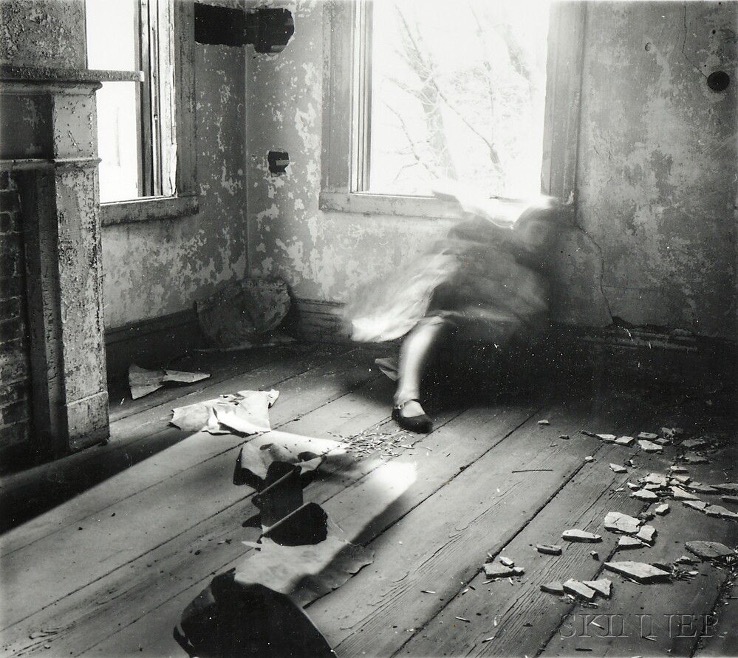
As the medium between the living and the dead, the photographic film is first and foremost a gothic technology. If Francesca Woodman’s art is compared to the work of feminist artists like Ana Mendieta, Friedl Kubelka, and Cindy Sherman, it is because her work is about the subversion of the male-centric relationship with “the woman as nothing more than an image” (and “the man as the bearer of the look,” according to Laura Mulvey’s definition). At the same time, it is also about the representation of another relation with the visual medium. It is gothic feminism, for lack of a better name: in Francesca Woodman’s photography, the female body returns again and again as the body of a ghost.
After the death of the author, as Roland Barthes theorised it, Francesca Woodman is the artist who now becomes the work of death within her photography. In the self-portraits, she is both the object of the imago and the subject who is casting it on her own body. Following Michel Foucault, then, “we should reexamine the empty space left by the author’s disappearance; we should attentively observe, along its gaps and fault lines, its new demarcations, and the reapportionment of this void; we should await the fluid functions released by this disappearance,” in other words, the ghostly traces that the author left behind. They, too, are nothing but images.
In 1982, Francesca Woodman killed herself at the age of twenty-two years old. In her last journal entry, she writes: “This is why I was an artist. I was inventing a language for people to see the everyday things that I also see, and show them something different. […] Simply the other side.” In hundreds of self-portraits, she showed that the image as such is less about what is visible than what is invisible in every representation: the imaginary.
Bibliography
Barthes, Roland (1977). The Death of the Author. In Stephen Heath (Ed.), Image, Music, Text (Trans. Stephen Heath) (pp. 142–48). London: Fontana Press.
Barthes, Roland (1993). Camera Lucida (Trans. Richard Howard). London: Vintage Classics.
Blanchot, Maurice (1982). The Space of Literature (Trans. Ann Smock). Lincoln: University of Nebraska Press.
Dillon, Brian (2023). Affinities. London: Fitzcarraldo Editions.
Foucault, Michel (1998). What Is an Author? (Trans. Donald F. Bouchard and Sherry Simon). In James D. Faubion (Ed.), Aesthetics, Methods, and Epistemology: Volume 2 (Trans. Robert Hurley and others) (pp. 205–223). New York: New Press.
Mulvey, Laura (1975). Visual Pleasure and Narrative Cinema. Screen, 16(3), 6–18.
Kafka, Franz (1988). The Diaries of Franz Kafka (Trans. Ross Benjamin). New York City: Schocken Books.
Kafka, Franz (2016). The Metamorphosis (Trans. Susan Bernofsky). New York: W. W. Norton.
Pedicini, Isabella (2015). Francesca Woodman: Gli Anni Romani tra Pelle e Pellicola. Roma: Contrasto.
Townsend, Chris (2006). Francesca Woodman. New York: Phaidon.
Wiley, Chris (2024). The Unseen Sides of Francesca Woodman. The New Yorker.
Willis, C. Scott (dir.) (2010). The Woodmans. C. Scott Films LLC.

