J. Igor Fardin
J. Igor Fardin holds a PhD from the Politecnico di Torino in the Urban and Regional Development program and is currently a student/researcher in Philosophy at the Global Centre for Advanced Studies (Dublin). His work lies at the intersections between architecture, contemporary philosophy, theology and psychoanalysis. This transdisciplinary research is aimed at developing theoretical tools that allow architecture to confront what it cannot build by investigating the notions of use and play, as well as the (non) relation between architecture and nature.
High Life is Claire Denis’s first film in English as well as her first sci-fi film. Like in the outer space of Tarkowsky’s Solaris—often mentioned as one of the main references for High Life—in Denis’s version there is no alien to fight nor new planet to conquer. As she put it in an interview about the film for the French newspaper Libération:
“It’s not about conquest. I prefer to see space as a place where humans contemplate and rethink their life on Earth” (Piette, 2018: online)
Indeed, there could be no conquest in a movie that revolves around a suicide mission to extract energy from a black hole. What’s more, the people taking part in this mission are not traditional heroes or frontiersmen. They are a group of criminals (Monte, Tcherny, Boyse, Chandra, Nansen, Mink, Ettore and Elektra) who have decided to exchange their death sentences on Earth for death in outer space. On this suicidal mission the criminals also serve as guinea pigs for Dibs, a convict/doctor whose mission is to create a fetus capable of surviving the radiation in outer space through artificial inseminations. By raping Monte (the main character and narrator) while he’s sleeping and injecting his sperm into Boyse, Dibs, the “shaman of sperm”, finally achieves her mission and gives life to Willow, a healthy baby girl. After a series of disturbing deaths and suicides, only Monte and Willow are left alive in the spaceship and the movie ends when the two, with Willow now an adolescent, enter a black hole.
This brief summary of the film already makes clear that Denis is not interested in projecting a new utopian life made possible by technology into outer space—a new life that would allow us to leave Earth, and its problems, behind. Her matchbox shaped spaceship, which Monte repairs with a wrench, does not inspire any faith in technological solutionism. The only impressive piece of technology in the spaceship is the “fuckbox,” a highly disturbing masturbating machine used by the convicts/astronauts.
Denis’s movie is clearly not concerned with the possibility of a future (technological) life in outer space. However, her movie is also not a naïve critique of technology but rather an attempt to address, by launching it into outer space, the question of genesis—the genesis of the human on Earth as well as the questions that a possible new genesis might bring about. In order to tackle the question of genesis, central to any project of radical politics, Denis’s movie projects into outer space two fundamental myths of Western civilization: the biblical myth of the Garden of Eden and the Freudian myth concerning the institution of taboo. It is these two myths that I want to explore through a psychotheological reading of High Life.[1] Yet, before directly addressing the ways in which these myths are taken up in Denis’s movie, we have to focus on the specific aspects of (her) outer space that bring to the fore the question of genesis.
Outer Space, or Retroactivity

In what I argue is a central scene of the movie, we see all the convicts/astronauts standing in an empty room and staring into space while the whole galaxy is converging in front of them. What they are seeing is explained by Monte’s internal monologue:
At 99% of the speed of light the entire sky converges before our eyes. This sensation, moving backward even though we are going forward, getting further from what’s getting nearer, sometimes I just can’t stand it.
This paradoxical sensation traverses Denis’s movie. Not only does its narrative structure continuously jump back and forth in time, but the more Monte and the other convicts/astronauts travel forward, the more they look back; the closer they get to their destination, the more it becomes evident they can’t rid themselves of Earth.
Even long after the spaceship has abandoned the solar system, Earth’s disturbing presence is still painfully felt on the spaceship. This disturbing presence is embodied by a series of random images from Earth that are still transmitted to the spaceship’s screens even years after all radio communication with our planet has been interrupted. The uneasiness they produce is articulated by Monte who, despite never turning off the screens, complains about “these fucking images from Earth […] it’s like viruses chasing after us, like parasites”. It would seem that the sensation produced by space travel has been interiorized by Denis’s convicts/astronauts who, the more they move away from Earth, the more they are drawn back to it.
Yet, this does not mean that Denis launches her convicts/astronauts into outer space to nostalgically turn towards Earth and depict it as an idyllic place to which we long to return. In an interview she clearly states that the movie started with the idea of portraying a man who has abandoned every hope to return to Earth and has no human company besides his child.[2] We also have to remember that all the convicts/astronauts are sentenced to death on Earth and therefore our planet has nothing to offer them; they do not have much to be nostalgic about. Moreover, a nostalgic reading would completely miss the uneasy sensation that outer space seems to produce in Monte and fail to account for the fact that he is painfully aware that he is going forward even though he has the impression of “getting further from what’s getting nearer”. Monte’s awareness in this regard emerges with particular clarity from a dialogue between him and Tcherny. When the latter tells him about the son he left on Earth and speculates about the way in which he would be raised, Monte tells him “your son is old now, or is dead”.
Denis’s outer space therefore prevents us from both holding a nostalgic view of our Earth and projecting ourselves into an idyllic future freed from Earth’s problems. High Life makes us dwell in the uneasy sensation of “moving backward even though we are going forward” and I believe this is what allows Denis to tackle the question of genesis in a peculiar way. Indeed, as I have already suggested, her movie seems to address both our own genesis, the one of Homo sapiens here on Earth, and the possibility of a new genesis in outer space. Put differently, consistent with the sensation that outer space produces in Monte and the other convicts/astronauts, Denis’s account of human genesis takes us simultaneously back to our pre-history and forward towards a post-historical new life, a High Life.
At this point it is important to be precise. The genesis that Denis’s movie interrogates cannot be reduced to the biological reproduction at the center of Dibs’s obsession, even though this is a necessary component of the movie. I argue that High Life’s main concern is symbolic and subjective genesis. This is why her movie restages and interrogates, by launching them into space, two symbolic accounts of genesis that have traversed western civilization: one is theological (the Garden of Eden) and the other is psychoanalytical (the institution of taboo). The centrality of these two accounts of genesis, as well as their intimate relation, is evident from the opening scene of the movie—the very first thing we see is a flourishing garden and the first thing we hear is a crying baby.
The Garden, or a Theological Aberration

For centuries, western civilization believed that the birthplace of humanity, the Garden of Eden, could be located in a specific region of Earth. As Jean Delumeau (1992) and Alessandro Scafi (2014) brilliantly showed, it was only in the 16th century that, in light of major geographical and cartographical developments, a different reading of the Garden slowly became prevalent.[3] The Garden became a spiritual state, an image of the beatitude achievable in this life through contemplation or knowledge. In this new perspective, if Edenic life were possible on Earth it would have to be separated from the rest of the sinning world, a separation that is perceivable, for example, in Theresa of Avila’s Interior Castle. This understanding of the Garden as a separated space found fertile soil in a medieval reading of the bible that, blending the garden of Genesis with the one of the Song of Songs, already understood the Garden as a hortus conclusus. Understanding the Garden of Eden as a closed space also drew a symbolic link between monastery gardens and paradise. Of course, monasteries needed gardens for practical reasons, but these spaces also had a symbolic meaning: they were spaces for contemplation separated from the world and the only space within the monastery where it was possible to directly gaze at the sky.
What’s more, understanding the Garden of Eden as a closed garden that is both pure and fertile allowed western Christianity to draw a link between the Garden of Eden and the body of the Virgin Mary. Mary, like the Garden of Eden, is a symbol of both fertility and pureness since she gave birth to Christ while remaining a virgin. This parallel explains the fact that certain 16th century annunciations draw a parallel between the garden that is Mary and the Garden of Eden by portraying the fall of Adam and Eve next to Mary and the archangel Gabriel.[4] For Christians, Mary giving birth to Christ represents the redemption of Adam and Eve; it is the passage from the age of law to the age of grace. Yet, this does not erase sin, and Adam and Eve are usually painted walking towards a deserted land with the tools to work it. In this regard, especially if contrasted with the joyous belief that Eden was located somewhere on Earth, this symbolic understanding of the Garden as a hortus conclusus is a nostalgic one (Delumeau 1992: 155-182). While the purity of (an interior) Edenic life could be grasped through contemplation and mystical experience by a selected few, for the rest of humanity, genesis happened once and for all; the condition of humanity is the one of Adam and Eve toiling the earth.
Yet, there is one Fra Angelico annunciation, today exposed at Madrid’s Prado Museum, which seems to tell a different story. Here Adam and Eve are expelled from Eden by the Seraphim and yet they do not toil a deserted land. Instead, they are in the pure and fertile garden of Mary and are about to stomp on her roses. This, as art historian Daniel Arasse puts it, is a “theological aberration” (2004: 108) that should make us doubt that the painting was actually done by Angelico. Indeed, in this painting, Adam and Eve are allowed to remain in a pure and fertile garden after having sinned—after the fall. Sinners are introduced into the pure and fertile garden of Mary (which mirrors the one of Genesis) without washing away their sins—as it is clear from the sad expressions on the faces of Adam and Eve. I believe that it is precisely this theological aberration that gives us a key to understanding the garden at the center of Claire Denis’s spaceship.
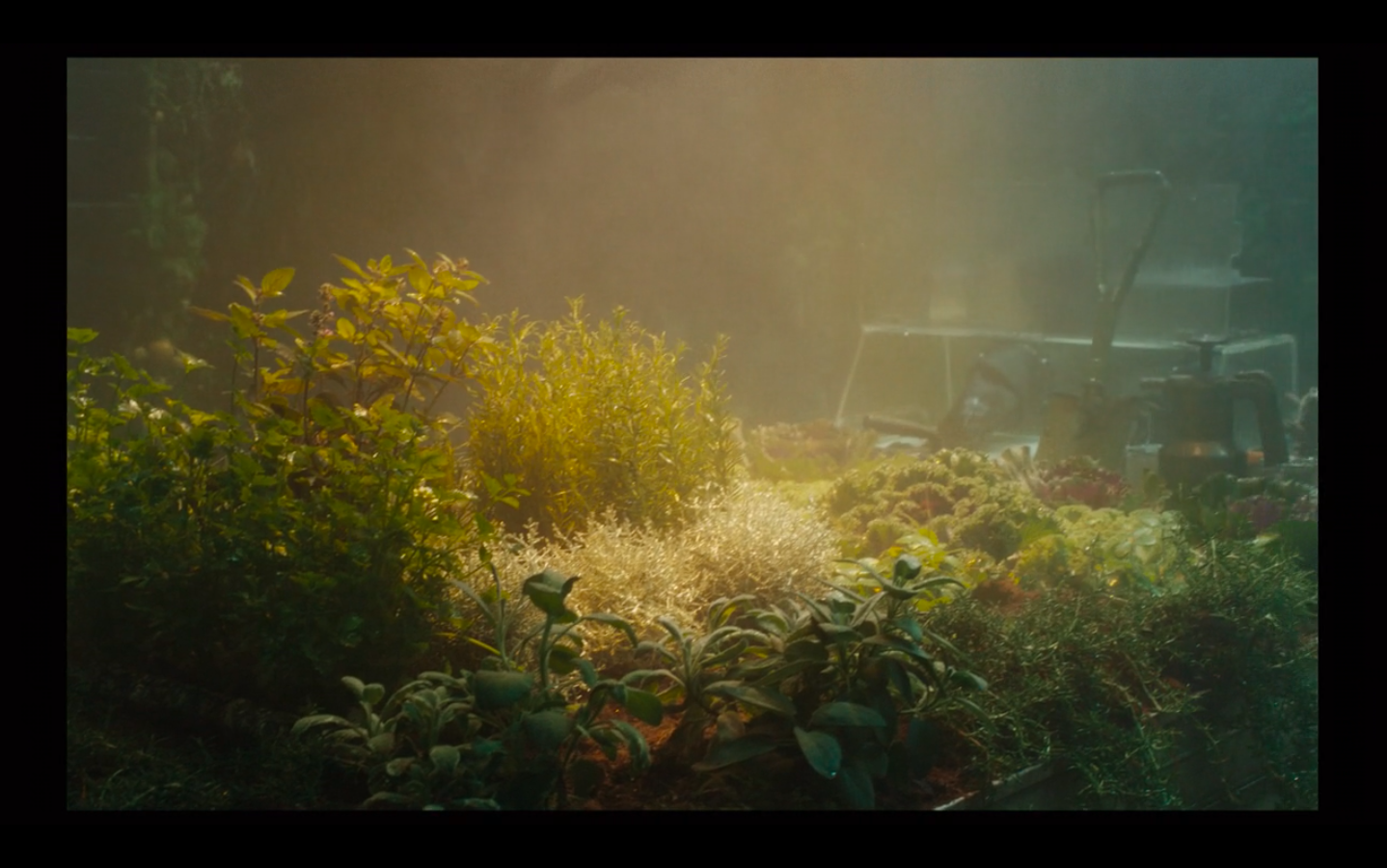
Like the gardens of monasteries, the spaceship’s garden is a hortus conclusus with a primarily functional role—supplying the convicts/astronauts with fresh vegetables, herbs and fruits—but also a symbol stretching towards something radically other, something escaping the finite space of the spaceship/prison. Yet, Monte and his fellow astronauts do not enter the garden to gaze at the sky and meditate about a paradise awaiting them in the next life. The garden is not turned towards the sky but towards Earth. Like the rabbis of a famous Talmudic parable, Monte and the others descend to the garden, which seems to be physically located below the other rooms of the spaceship. This specific location of the spaceship garden already gives us a hint of what the garden might symbolize for Monte and the other people on the spaceship. It is neither a terrestrial figure of paradise, nor a place geographically located on Earth; it is Earth. This is why Tcherny, after admitting “I can’t do this space shit no more” decides to sleep in the garden and to die there. Arguably, this is also why it is from the garden that Boyse collects dirt to try and give Elektra a symbolic funeral and why, when an alarm goes off, Boyse and Mink go to the garden and rub dirt on their hands and faces. To a certain extent, Denis’s garden maintains the dimension of nostalgia that marks the hortus conclusus described above. The garden can be understood as a symbol of what is lost to Denis’s characters—Earth.
However, this is not all there is to Denis’s garden. Earth is not a romanticized place that, through nostalgia, could become fertile and pure. As Monte ironically notes while working with Tcherny in the garden “I like it here, it reminds me of juvy, it reminds me of jail, same thing as the army”. The Garden is not the symbol of a pure and fertile lost condition that one could renew through contemplation. Monte and Tcherny do not purify themselves through meditation; they do not wash themselves in the river Lethe, as Dante did when entering Earthly Paradise in the Divine Comedy. Like the Adam and Eve of the Prado’s annunciation, they enter the garden with their sins and yet, despite this, the garden offers them the possibility for a new genesis, a new beginning that, while it cannot erase the past (Adam and Eve remain sad, and Monte thinks about juvy), can nevertheless open onto a new life. This new life is a High Life that the garden maintains while also somehow keeping it tied to Earth. This is the life of a father (Monte) who knows that no return to Earth is possible, and of a daughter (Willow), a baby born in outer space for whom Earth does not mean anything in particular.
The Law, or Godless Prayers
The garden is not the only myth of genesis that western modern culture has inherited. In Totem and Taboo (1913), Sigmund Freud proposes another myth for the birth of humanity—the one of the primal horde and the killing of the Father. To summarize it briefly, Freud proposes to understand the first society as ruled by a despotic and violent father that is subsequently killed by his sons who, after killing him, establish an inaugural pact instituting the law in the form of taboo (mainly marking the prohibition of incest) in order to avoid a return to the previous condition. This reading of anthropogenesis allows Freud to put forward an origin myth for the structure he called the Oedipus complex and to tackle the question of how this (unconscious) structure could be carried through from one generation to another. For Freud “we may safely assume that no generation is able to conceal any of its more important mental processes from its successor” and therefore “[a]n unconscious understanding such as this of all the customs, ceremonies and dogmas left behind by the original relation to the father may have made it possible for later generations to take over their heritage of emotion” (2015: 184).
Lacan engaged with Freud’s myth both in his 1960 Seminar VII: The Ethics of Psychoanalysis and in a lecture given at the catholic Saint-Luis University in Brussels. In the latter, he makes clear that, for him, Totem and Taboo investigates “the subject’s relation to being, assuming this relation is based on discourse” (2015: 21). The Oedipus complex, for Lacan, is therefore not to be anchored in phylogenesis, or “the hereditability of acquired traits,” as Freud seems to suggest in Totem and Taboo, but rather, in “the tradition of a condition which, in a certain way, grounds the subject in discourse” (22). Put differently, for Lacan, Freud’s myth of the killing of the father, which would allow us to understand how “something like the order of the law may be transmitted” (Lacan 1997: 176) has to be related to the subject’s entry into language, to what Lacan famously called the Nom-du-Père, a signifier which subjectively structures the symbolic field. The Law and the institution of taboo, following this reading, are not what hinder or prohibit the desire necessary to the birth of the subject—they are not moral, juridical or societal laws—but rather what make it possible.
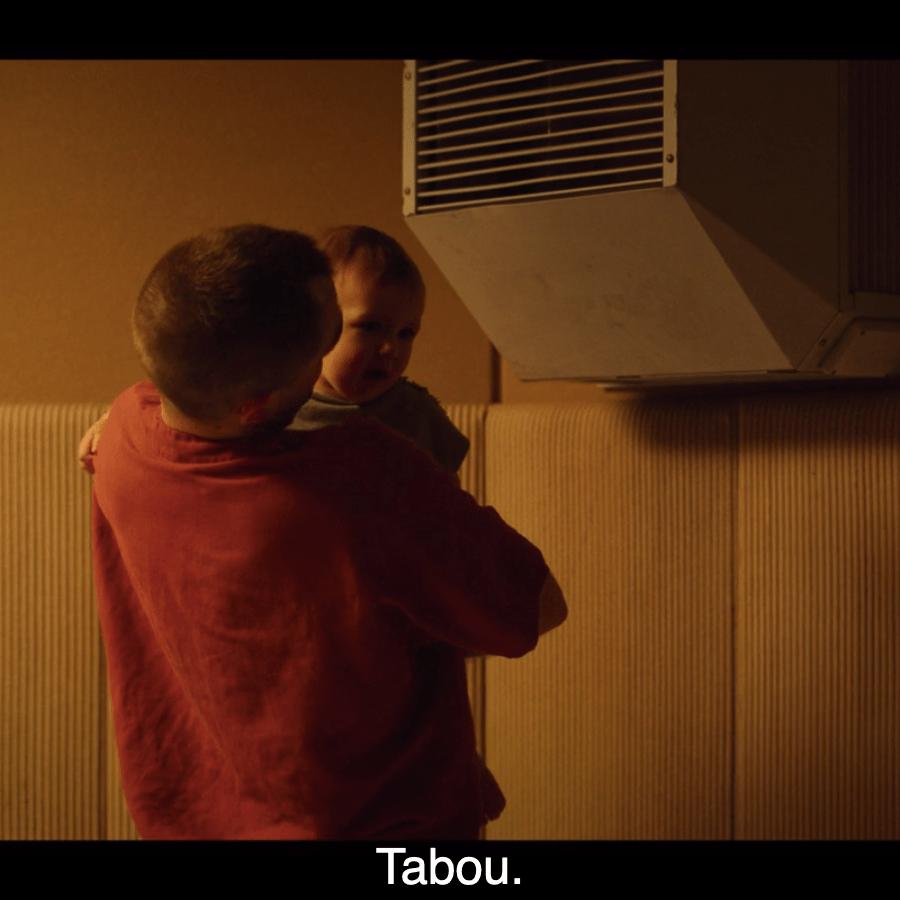
This psychoanalytical account of genesis is also central to Claire Denis’s movie. Indeed, Monte carried into the ship’s garden not only memories from his past life on Earth, but also the structuring features of his life on Earth. This is evident from the very beginning of the movie where, after feeding and cleaning baby Willow, Monte tells her: “you don’t drink your own piss Willow, and you don’t eat your own shit, even if recycled, even if it doesn’t look like piss or shit anymore…it’s called a taboo.” He then quickly adds, “at least it is for me, but not for you”. Is it really the case, though? Of course Willow will eat her own recycled shit that is probably used as a fertilizer, but this does not necessarily mean that there are no taboos for her and that she will not inherit a form of subjectivity structured by the Oedipus complex. If we follow Lacan in understanding the structure put in place in Totem and Taboo as the “tradition of a condition that grounds the subject in discourse,” then we could argue that she will inevitably form a subjective structure that could be understood within the Oedipal framework since she will be introduced to discourse by Monte who has inherited this “tradition.” Yet, we could also argue that growing up in outer space with no human interlocutors besides her father could also cause her to develop a different form of subjectivity. Ultimately, what is at stake is not so much what Willow would eat or drink, but her relation to the taboo of incest. The question is therefore: will Willow break the law of incest?
Denis does not answer this question, and in so doing she suggests neither the infinite repetition of Oedipus nor a completely new form of subjectivity. Yet, while Denis does not give us answers, she restages this central question of ontogenesis in different scenes of the movie, always leaving us unsure about what these scenes might mean and sometimes suggesting one outcome and sometimes the other. For example, she shows us Willow sleeping in bed with Monte and leaving traces of menstruation on the bedsheets. We also see Willow asking Monte to keep a puppy he found in an abandoned spaceship, which would allow her to have a relation beyond her father, only to accept Monte’s refusal with the words “you were right dad, I have everything I need here”. Yet, there is one scene or, rather, one dialogue that restages the question of Willow’s ontogenesis in a particularly touching way. The scene starts with those images from Earth that mysteriously keep on reaching the spaceship. More precisely, we see the beginning of a rugby match and a bagpipe playing the folk song “Flower of Scotland.” The camera then cuts to Willow, who is kneeling with her hands together and her eyes closed. The dialogue starts when Monte surprises her in this position and goes as follows:
Monte: What are you doing?
Willow: Praying.
Monte: Do you know what god to pray to? What god are you praying to?
Willow: I saw it in some of the random images from Earth. I just wanted to know what they feel.
In this dialogue, the paradoxical subjective position of Willow emerges in all its clarity. It is evident that, for her, not only is god dead, but there never was a god. She does not know which god to pray to and is therefore completely free from any notion of god or, to be more precise, from any content that would invest the signifier god. Indeed, the signifier god has no specific meaning for her, but it seems to play a role nonetheless. Willow is able to start anew as the Eve of a new world without gods (whether religious or secular). And yet, she still wants to figure out what praying feels like. This scene seems to suggest that, by piecing together images from Earth with her father’s unconscious, Willow inherited something—a structure that still compels her to pray.
Conclusions or Yellow Light

High Life asks crucial questions about what it would mean for humanity to start anew, questions that should be seriously addressed by any project of radical politics. However, the movie ends with Monte and Willow entering an ever-growing warm yellow light that gradually envelops the entire screen, leaving us without answers. We do not know if the sinners she placed in the garden of genesis will be able to remain in the garden or if they will once again be expelled to toil the earth, and we do not know whether Willow and Monte will break (or have already broken) the taboo of incest. Yet, this does not matter, and how could Denis have these answers anyways? What matters is her way of asking the questions, her gesture of launching genesis into outer space. In her film, outer space is not the locus of conquest or technological salvation but the stage that allows her to ask (at times uncomfortable) questions concerning our life on Earth and the possibility for a radical change within it.
Bibliography
Ambrose, S. (2004). Hexameron, Paradise, Cain and Abel (J. J. Savage, Trans.; Translation edition). The Catholic University of America Press.
Arasse, D. (2006). Histoires de peintures. Folio Essais.
Delumeau, J. (1992). Une histoire du paradis. Tome 1, Le jardin des délices. Hachette.
Freud, S. (2015). Totem and Taboo (1st edition 1913). Routledge.
Lacan, J. (1997). The Seminar of Jacques Lacan: The Ethics of Psychoanalysis (J. Alain-Miller, Ed.; D. Porter, Trans.). W. W. Norton & Company.
Lacan, J. (2015). The Triumph of Religion (B. Fink, Trans.; 1st edition). Polity.
Piette, J. (2018). “Claire Denis: ‘Le film m’a permis d’imaginer la fin de l’humanité comme le devenir d’autre chose’.” Libération. Online. Available at: https://www.liberation.fr/cinema/2018/11/06/claire-denis-le-film-m-a-permis-d-imaginer-la-fin-de-l-humanite-comme-le-devenir-d-autre-chose_1690308/ (accessed 25.04.25).
Santner, E. L. (2001). On the psychotheology of everyday life: Reflections on Freud and Rosenzweig. University of Chicago Press.
Scafi, A. (2014). Maps of Paradise. University of Chicago Press.
[1] My use of the term psychotheology, suggesting a dialogue between theology and psychoanalysis draws on Eric Santner’s book On the Psychotheology of Everyday Life (2001).
[2] Denis affirms this in her answer to a question posed by a journalist at the 2018 San Sebatian Film Festival available at: https://www.youtube.com/watch?v=FesLFwGdL3M (accessed 25.04.2025).
[3] This does not mean that before this date there were no speculative readings of Genesis that brought to the fore a more figurative reading of the Garden. Already, Ambrose proposed a figurative reading of the second book of Genesis. See Ambrose 2004.
[4] For example, in Fra Angelico’s Crotona annunciation (1434).
 JOURNAL OF THE FIRST OUTERNATIONAL